

Why Match-Fit Optic Cuts Improve Pistol Optic Mounting Security

Updated: Aug 1
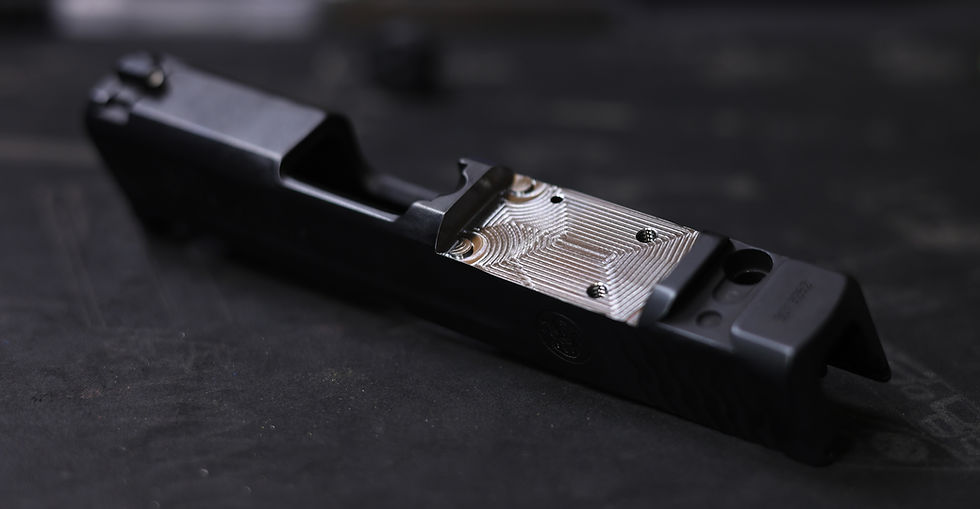
A secure pistol-optic installation depends on more than screw torque alone. The optic, mounting pocket, recoil features and fasteners should work together as a system. A match-fit optic cut is machined around the customer’s actual optic so the optic body is closely supported by the pocket and movement under recoil is minimized.
At Nameless Armament our goal is straightforward: maximize contact, minimize tolerance stack and create a more secure optic-mounting interface.
What is a match-fit optic cut?
A match-fit optic cut is an optic pocket machined to the measured dimensions of the individual optic that will be installed. Instead of relying only on the nominal dimensions published for an optic footprint, we measure the customer’s optic and machine the pocket to fit that specific unit.
This matters because two optics with the same footprint designation can vary slightly in overall length, width and the location of their mounting features. Slides and cutting tools also have tolerances. When those variations stack together, a one-size-fits-all pocket often leaves more clearance around the optic than necessary.
A match-fit process accounts for the optic that will actually be mounted to the slide.
What holds a pistol optic in place?
The mounting screws are essential. Their primary job is to clamp the optic to the mounting surface and maintain that clamping force.
The best mounting system isn’t the one with the strongest screws—it’s the one that gives the screws the least amount of work to do.
A closely fitted pocket helps accomplish this by supporting the optic at the front and rear. This close contact, together with the recoil features, helps resist fore-and-aft movement and transfer recoil forces through optic body instead of requiring the mounting screws to resist those forces alone. The screws can then perform their primary role: maintaining clamp force.
This does not make the screws optional. Correct fasteners, thread engagement, torque and thread-locking practices remain critical parts of a secure installation. Match-fit machining allows the pocket, recoil features and mounting screws to work together as a complete system.

How tolerance stack affects optic fit
Every manufactured component has an allowable range of variation. The optic may be slightly larger or smaller than its nominal specification. The slide, cutting tool and machining setup each introduce their own tolerances as well.
A universal production cut must accommodate optics across the permitted size range. To ensure that every compatible optic will drop into the pocket, the pocket generally needs enough clearance for the larger examples. A smaller example of the same optic can therefore have additional space around it.
That clearance is the tolerance stack. It does not automatically mean an installation will fail, but reducing unnecessary movement gives the optic a more supportive mounting interface. This in turn greatly reduces the likelihood of screws loosening or snapping during operation.
Match-fit cut versus universal production cut
A universal production cut is designed for interchangeability. It allows different optics within a footprint family to be installed without measuring each individual optic. That is convenient for large-scale production and makes future optic replacement simpler.
A match-fit cut prioritizes close support around the optic being installed. It requires the actual optic during machining and may require fitting if the optic is replaced later.
The difference is where each method places its priority: broad interchangeability or an individually fitted interface designed for maximum security.
Why we require the customer’s optic
For a true match-fit cut, we need the optic that will be mounted. A model name or published footprint drawing tells us the general interface, but it does not tell us the exact dimensions of that individual optic.
We measure the optic, establish the machining dimensions and check the fit during the cutting process. This lets us control the relationship between the optic body and the pocket instead of assuming that every optic bearing the same model name is identical.
Why manufacturers usually cannot match-fit every slide
A manufacturer making thousands of slides has to build around interchangeability. The optic that will eventually be installed is not available when the slide is machined, and the pocket must accept a range of compliant optics.
That is a practical production requirement, not necessarily poor workmanship. Custom machining serves a different purpose. Because we have both the customer’s slide and optic at the same time, we can fit the interface as a pair.
Does an optic return to zero after removal from a match-fit pocket?
In our experience and testing, yes. A closely fitted pocket improves the consistency with which an optic returns to its seated position after removal and reinstallation. However, return to zero should never be assumed; it should always be verified.
Any time an optic is removed, the fasteners, mounting surfaces and thread condition should be inspected. The optic should be installed using the appropriate procedure, and zero should be confirmed before the firearm is relied upon.
What happens if the optic must be replaced?
Individual fit creates an important tradeoff. A replacement optic of the same make and model may not have exactly the same external dimensions as the original.
If the replacement is larger, it may need to be professionally fitted to the existing pocket. If it is smaller, it may not have the same degree of close support. Customers should understand this before choosing match-fit machining.
This is one reason we describe match-fit machining as a precision service, not simply a generic footprint cut.
Are all Nameless Armament optic services match-fit?
No. Some services solve a different mechanical problem and should not be described as match-fit.
For example, our Smith & Wesson M&P Shield optic-pocket correction service addresses the angle of the factory-machined pocket. Some factory optic-ready slides have a pocket that slopes downward toward the muzzle, which can prevent a mounted optic from having enough elevation adjustment to zero.
For that service, we remachine the pocket so the mounting surface is flat and parallel to the barrel's bore axis. We also modify the factory lugs as required for compatibility with the Holosun 407K, 507K, EPS and EPS Carry.
The factory pocket is already oversized, and the correction does not make it match-fit. Its purpose is to correct the pocket angle so a compatible optic can be mounted and zeroed properly.

Our match-fit machining process
Although the exact process depends on the slide and optic combination, a typical project includes:
Confirming the slide, optic and footprint compatibility.
Inspecting and measuring the customer’s individual optic.
Establishing the cut location, depth and mounting geometry.
Machining the pocket around the measured optic dimensions.
Checking the optic-to-pocket fit during the process.
Preparing the mounting surfaces and completing the selected finish work.
Installing the optic with the correct mounting hardware and verifying the final fit.
Performing a final quality-control inspection.
The objective is a complete mounting interface—not simply a cavity shaped like an optic footprint.
What do our screwless-fit demonstrations show?
In videos we frequently share on our social media pages, we demonstrate the close fit of our optic cuts by showing the optic retained within the pocket before the mounting screws are installed. These demonstrations provide a visual example of the contact between the optic body and the front and rear walls of the machined pocket.
The purpose of these videos is to show how little unnecessary fore-and-aft clearance remains after match-fitting. That close contact allows the pocket to help resist optic movement under recoil instead of requiring the mounting screws to resist the fore-and-aft forces alone.
These demonstrations do not suggest that the pistol should be fired or carried without mounting screws. Correct fasteners and installation remain essential. The videos demonstrate the mechanical support provided by the match-fit pocket before the complete mounting system is assembled.
Is a match-fit optic cut the right choice for you?
A match-fit cut may be a strong choice if your priority is optic mounting security. By creating an individually fitted interface with close support around the optic body, a match-fit cut minimizes avoidable movement within the pocket and helps the complete mounting system resist movement under recoil.
A universal cut may make more sense if your highest priority is being able to swap optics or replace one without additional fitting. The additional clearance that provides this interchangeability may offer less support around the optic body than an individually match-fit pocket.
The choice ultimately comes down to which benefit matters most to you: the mounting security of an individually fitted optic interface or the convenience of broader optic interchangeability.
Frequently asked questions
Does a match-fit optic cut eliminate the need for recoil lugs?
Not necessarily. The ideal mounting geometry depends on the slide and optic footprint. Recoil features, pocket contact and fasteners can all play a role in the mounting system.

Do the screws still matter with a match-fit cut?
Yes. Absolutely. Match-fit machining does not replace proper screws, torque, thread engagement or thread-locking practices.
Can you machine the slide without receiving my optic?
For a true match-fit service, no. We need the individual optic to measure it and verify the fit. Some correction or conversion services may not require the optic; the product description will say what must be sent.
Will any replacement optic of the same model fit?
Not always. Manufacturing variation means a replacement may be slightly larger or smaller than the original. Contact us before attempting to force a replacement optic into a match-fit pocket. If remachining or recoating is required to fit the replacement, we perform that work at no charge; the customer is responsible only for shipping.
Is match-fit the same as an optic-pocket correction?
No. A match-fit cut controls the pocket around a specific optic. A correction service repairs or changes an existing pocket’s geometry. The M&P Shield angle-correction service is an example of a correction that is not match-fit.
Does match-fit machining guarantee that an optic will never move or lose zero?
No machining method can eliminate every variable. Optic condition, fastener selection, thread engagement, installation, impact and normal use can all affect the mounting system.
However, match-fit machining greatly reduces the opportunity for the optic to shift within the pocket by minimizing unnecessary clearance and closely supporting the optic body. By resisting fore-and-aft movement under recoil, this close support reduces the load transferred to the mounting screws and lowers the likelihood of the optic shifting, the fasteners loosening or the optic losing zero.
Correct screws, torque and installation practices remain essential, but match-fitting provides an additional level of mechanical support that improves the security of the complete optic-mounting system.
Why Nameless Armament uses this approach
We machine, inspect and finish our optic-cut work in-house in Arizona. Controlling each stage of the process allows us to measure the individual components, monitor the fit during machining and verify the completed mounting interface before the slide leaves our shop.
We use the customer’s individual optic because optics of the same make and model can vary slightly in their external dimensions. Machining solely from nominal footprint dimensions would not account for those individual variations. Measuring the actual optic allows us to reduce tolerance stack and create close contact between the optic body and the pocket.
That close fit directly contributes to mounting security. By minimizing unnecessary clearance, the pocket helps resist fore-and-aft movement under recoil and provides mechanical support around the optic body. This allows the pocket and mounting screws to work together as a complete system instead of relying primarily on the screws to resist movement.
For us, match-fitting is not an aesthetic detail or a marketing term. It is a deliberate machining approach designed to reduce the possibility of the optic shifting or coming loose. Mounting security is our highest priority because your setup needs to be dependable when you can’t afford for it to let you down. After all, it’s only what you aim with.
About the author
Nate K. is the founder of Nameless Armament, a veteran-owned precision-machining shop in Avondale, Arizona. He develops the shop’s machining processes and personally performs its pistol optic cuts, adapter-plate machining, optic-pocket corrections and related slidework in-house.


Comments