

A deep nerdy dive into match-fit optics...


Secure mounting of a pistol optic is an often miss-understood and an often hotly debated topic in the industry. From what we have found it comes down to one core principle:
Mechanical recoil engagement + rigid metal-to-metal clamp + correct fasteners + proper torque/adhesive.
Below are some of the most important factors if you want to mount an optic as securely as possible to a pistol slide and keep it in place.
1) Direct-milled slide with tight optic fit
In our experience this is the gold standard.
Key features of the strongest setup
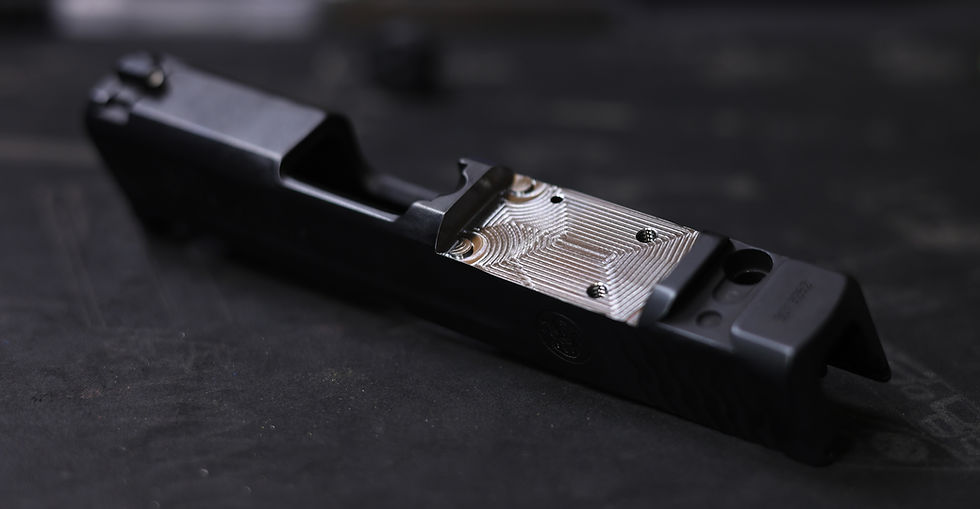
Optic footprint cut directly into the slide
No adapter plate (plates add tolerance stack + extra screws).
Precision fit pocket & recoil bosses
Optic should have zero to near-zero play before screws are installed.
Shear forces are carried by the pocket, optic body, and bosses, not the screws.
Why this is strongest: screws are poor at resisting repeated shear shock.
Direct milling / match fitting allows:
Steel-to-optic contact take recoil
Screws provide pure clamp load only
That dramatically improves durability which we will explore in greater detail below.
2) Proper screw engineering (critical and often overlooked)
Best-practice specs
High-strength quality steel screws
Correct thread engagement depth ~1.5× screw diameter in steel is ideal.
Screw holes in the slide machined to the correct dimensions and tolerance
Maximizes bearing area and clamp consistency.
Correct length (no bottoming out)
Thread treatment
Medium-strength threadlocker (Loctite 243/VC-3 depending on philosophy)
Threadlocker provides:
Friction stabilization
Vibration resistance
Corrosion protection
3) Torque control and preload
Typical optic screw torque is 10–20 in/lb depending on screw size & manufacturer. The security comes from repeatable preload, not maximum torque.
Best practice:
Degrease screw + hole
Apply threadlocker correctly
Torque with a calibrated inch-pound driver
Allow full cure time.
4) So, what are the geometry details that separate “good” from “duty-grade”?
Ultra-secure milling characteristics
Precision direct-milled optic cut with tight fit
Parallelism between screw holes and pocket floor (ensures even clamp load)
High-strength properly sized screws with correct thread engagement
Calibrated torque with medium threadlocker
No elastomer or plate in the load path.
This is where you can really separate a generic optic cut from a true duty-grade machining job.
Critical Pocket Dimensions
Listed below are the critical optic pocket dimensions and tolerances that matter most for a pistol optic direct mill if you want the most security out of the interface.
1) Pocket fit (arguably the most important)
What matters
The front-to-back clearance between the optic body and optic pocket walls. Duty-grade/severe use target:
Typically, about 0.0005–0.001 in total clearance.
This level of fit is achievable only in measured match-fit machining and is not realistic for universal footprint cuts.
This provides an optic fit without forcing or damage and near-zero shift before screws are installed.
Here’s why it’s critical. Recoil generates longitudinal and lateral impulse. If clearance is large:
Screws experience shear shock
Holes elongate
Zero shifts over time
With a tight pocket the optic body directs recoil force directly into the slide, not through/into the screws.
2) Recoil boss geometry
Key variables
Boss height
Boss diameter
Location tolerance relative to screw holes
Common weak design
· Bosses too small → point loading → deformation.

3) Pocket floor flatness & parallelism
Requirements
Floor should be flat within ~0.001 in.
Floor must be perpendicular to front and rear optic pocket walls
If the pocket floor is uneven:
clamp load concentrates on corners
optic flexes during recoil
screws loosen sooner
This is a hidden durability killer.
4) Screw hole quality
Critical factors
Perpendicularity to pocket floor
True positional accuracy
Adequate thread engagement
Correctly machined dimensions/clearance between the fastener and its bore (thread class)
Poor machining causes
Angled screws result in uneven clamping/engagement
False torque readings
Gradual loosening or breakage
Stripped or snapped fasteners
The optic pocket features above are paramount in keeping an optic securely mounted under even the worst conditions.
Match-fit optic cuts vs. generic footprint cuts
Both can work, but they behave very differently under recoil stress.
1) What a true match-fit cut changes mechanically
A match-fit process machines the pocket to the exact measured optic you send in, rather than the nominal optic blueprint.
Mechanical effects
Near-zero clearance
Optic body contacts slide walls
Shear load transfers steel-to-optic body, not into screws.
Reduces/eliminates screw bending, hole elongation, zero shift over time.
Higher frictional resistance
Large surface contact area between optic and pocket.
Clamp load produces real shear friction, not just screw tension.
Reduced micro-impact
Less “start-stop” movement during recoil impulse.
Drastically reduces/eliminates fatigue on screws, optic housing, and slide threads.
From a pure mechanics standpoint, this is the strongest possible retention short of an integral optic design.
2) Downsides of match-fit machining
Optic interchangeability drops. Because tolerances vary between optics:
Another optic may not fit.
Even same-model optics can differ a few thousandths.
So:
Match-fit = strongest retention
Generic cut = best compatibility.
Thermal expansion margin is smaller. Very tight steel-to-aluminum fits mean:
Heat can slightly increase contact stress.
Usually safe, but engineering margin is tighter.
High-round-count duty guns typically still tolerate this fine.
Refinish thickness matters more. Coatings like Cerakote can change the fit but .001 to .002”. Match-fit shops must control coating thickness carefully.
3) Generic “footprint spec” cuts (the industry default)
Most milling uses:
Published optic footprint dimensions
Small clearance added for universal fit.
Mechanical behavior
Slight play before screws clamp
Screws see initial shear impulse.
Over thousands of rounds: screws loosen sooner, holes can peen, zero drift risk increases.
Still perfectly serviceable—just not maximally robust.
4) When match-fit is objectively better
Best for:
Duty / defensive pistols
High round count training guns
Competition guns with heavy recoil cycles
Users who:
Won’t swap optics often
Want maximum durability.
5) When generic cuts are the smarter choice
Better if you:
Frequently change optics
Sell/trade optics often
Want easy replacement after optic failure
Run multiple optics across slides.
To summarize this section: From a stress-path and fatigue standpoint match-fit direct milling is the mechanically strongest removable optic mounting method available on a pistol slide.
From a logistics and serviceability standpoint generic footprint cuts are more flexible and can be reliable enough for some use cases.
Bottom line for match fitting: This approach prioritizes maximum retention and durability over interchangeability and universality - which is a defensible, engineering-sound design philosophy, especially for hard-use pistols.
Calculations, Examples, and The Why
Now, let’s run a simplified but realistic engineering estimate of the forces acting on an optic mounted to a Pistol slide, and compare them to:
Screw shear strength
Friction from clamp load
Effect of pocket fit
This is where the physics becomes very revealing on why a match fit between the optic and slide have advantages in keeping the optic securely mounted.
1) Recoil acceleration of a pistol slide
Typical values used in firearm dynamics studies:
Slide velocity: ~15–20 ft/s (4.5–6 meters/second)
Time to reach that speed: ~1–2 milliseconds
Resulting acceleration: Peak instantaneous inertial force during slide impact can approach 2000-4000 g’s
That sounds extreme, but short duration impacts commonly reach thousands of g’s in peak acceleration.
2) Mass of a pistol optics
Pistol optics can weigh in on average from 30 grams to up over 60 grams with most modern optics coming in around 45 grams to 55 grams. So let’s use 50 grams as an example (so 0.05 kg)
3) Inertial force during recoil
Using: Force = Mass X Acceleration
Take mid-range acceleration:
3,000 g ≈ 29,400 m/s²
You get: F = 0.05kg × 29,400 m/s² ≈ 1470 N
1470 N Converted ≈ 330 lbf of peak instantaneous inertial force
The optic is ripped backwards and then slams to a stop with about 250 - 400 pounds of peak force every shot. And this repeats thousands of times.
4) Can the screws survive pure shear?
Well, if we take the following:
Typical optic screws:
Size: 6-32, M3, or M4 (we will use 6-32 in our examples below)
Material: alloy steel (≈120–160 ksi shear strength)
Typical alloy steel screw shear strength:
Tensile strength ≈ 120–150 ksi
Shear ≈ 60% of tensile → 70–90 ksi
The approximate tensile stress area for a 6-32 fastener is around 0.0133 in²
So that means that the approximate shear per screw (6-32): 0.0133 in² × 80,000 = 1064 lbf per screw. Two screws would then be around 2100 lbf shear capacity. And this is an optimistic “perfect conditions” example.
Using the torque-preload relation T = K × F × D for a 6-32 fastener where:
D or Major Diameter is = 0.138 in
K or the Torque Coefficient/Friction = 0.18–0.22 (lubed with threadlocker)
We solve for F or Clamping Force by reworking the equation to F = T / (K × D)
Using a K value of = 0.2:
F = 15in/lbs / (0.2 × 0.138)So the clamping force = 543 lbf per screw
Even using K value of 0.18 we still only get to 600–650 lbf per screw. So the realistic clamp load is closer to 1,100–1,300 lbf total (two screws)
Conclusion: Yes, the screws are strong enough. Even if we took worst case of 400lbf of recoil force, 6-32 fasteners would have a safety margin of 3.25x. So, what is causing all the controversy and the issues? The truth is that fatigue & micro-movement are the major enemies of the optic mounting system.
5) Clamp load and friction (the real retention mechanism of a loose-fitting optic)
If you remember from above, a properly torqued 6-32 fastener at 15 in/lbs:
Clamp load per screw ≈ 650 lbf
Two screws → 1300 lbf clamp
Friction force:
Friction Force = μ × clamp. For steel-to-anodized aluminum μ ≈ 0.3. With modern coatings and surface treatments like PVD/DLC and Nitride this is more realistically less at around 0.1 to 0.2.
So, using the following ranges:
Low end: 0.1 × 1300 = 130 lbf
Midpoint: 0.2 × 1300 = 260 lbf
High end: 0.3 × 1300 = 390 lbf
So friction resistance is around 130 lbf - 390 lbf
6) Compare friction vs recoil force
Here's where this gets important:
Recoil shear force: ~250 lbf to 400 lbf
Friction resistance: ~130 lbf to 390 lbf
That’s the key insight; the system can end up operating below or right on the edge when relying only on screw friction alone (aka a loose-fitting optic pocket).
So, any reduction in clamp load from vibration loosening, embedment, thermal cycling, or tolerance gaps allows micro-slip. This ultimately leads to zero drift, and screw fatigue.
7) What tight optic to pocket fitment changes:
If the optic is supported tightly by the steel pocket walls:
Initial impulse transfers through bearing surfaces
Screws still experience some bending & fluctuating tensile stress
But the shear amplitude on the fasteners is dramatically reduced
Friction becomes secondary safety, not primary.
This massively improves:
Fatigue life
Zero retention
Screw survival.
Engineering takeaway: Without a tight optic fit, the system depends on:
Small screws and marginal friction
Operating under 390 lbf repeated shock.
With tight direct-mill engagement the system becomes: steel-to-optic recoil bearing with screws only clamping. That’s substantial durability improvement in fatigue terms. These physics examples are why serious duty optic mounting always trends toward:
Tight fit
Proper torque + threadlocker
Minimal reliance on screw shear
This is why match-fit machining (like we discussed earlier) has real mechanical merit.
Let's Wrap It Up
Finally, we can look at fatigue life and loosening over thousands of recoil cycles, which is really the heart of optic-mount durability. I’ll keep the math simplified but physically realistic.
1) What causes screws to loosen in pistol optics
It's not immediate shear failure. Instead, loosening comes from micro-slip each firing cycle:
1. Recoil force briefly exceeds friction from clamp load
2. Optic shifts a few microns (one micron is about 39 millionths of an inch)
3. Clamp load relaxes slightly
4. Repeat thousands of times → screw backs out or zero drifts
This is classic transverse vibration loosening (Junker effect).
2) Cyclic load magnitude vs friction margin
From earlier:
Recoil shear per shot: 250 lbf to 400 lbf (depends on ammunition load, how the pistol is sprung, optic weight, etc.)
Friction from clamp (ideal): ~130 lbf to 390 lbf
Depending on surface condition and preload loss, friction-only retention (loosely fit optics) may operate with limited dynamic safety margin. That can be a very real recipe for failure. Further, anything that reduces preload even 10–20 % will likely causes major issues such as slip to begin. Which brings us to…
3) How fast preload decays without a tight-fitting optic
Experimental vibration studies of small fasteners show:
Initial preload loss: 10–30 % in first few hundred cycles
Continued decay until threadlocker carries load or screw rotation begins
Applied to pistols, it would be hard to give specific round counts of when failures would occur due to all the variables involved. Typically, within a few thousand rounds symptoms such as a shift in zero, reduced torque of the fasteners, and dislodging of the optic can occur which matches many shooter reports.
4) What changes when tight match-fit walls carry shear
Now the physics changes completely. Fatigue life of the joint increases dramatically:
Shear force goes into the slide, not the screws
Friction is no longer the primary restraint
Micro-slip amplitude per cycle is greatly reduced
Screws usually remain tight if threadlocker used
Failures typically shift to optic electronics, lens, & emitter rather than mounting.
This is exactly what duty-gun endurance tests show.
5) Role of threadlocker in fatigue life
Threadlocker does two different jobs depending on how well the optic fits the slide:
Without a tight-fitting optic, it acts as:
primary anti-rotation mechanism
absorbs micro-movement
In this case the threadlocker is being overworked.
With a tight optic fit, threadlocker acts as:
A secondary vibration damper
A corrosion barrier
A preload stabilizer
This is the ideal engineering use case.
6) Why match-fit cuts extend life even further
Compared to standard boss cuts:
More surface contact area
Less initial clearance
Lower impact velocity during recoil reversal
Fatigue damage scales roughly with slip distance so even a 50 % reduction in micro-motion can mean several-times longer service life.
7) Big-picture engineering comparison
Generic footprint:
Screws carrying shear
Depending on surface condition and preload loss, friction-only retention may operate with limited dynamic safety margin.
Commonly observed maintenance/repair intervals: ~1–3k rounds
Long-term risk: zero drift / screw loosening
Tight match-fit direct mill
Highest fatigue resistance
Minimal micro-motion
Longest zero retention
Lowest screw stress
Safety factor: much higher
Typical failure mode: optic failure, not mount/interface
Mechanically, this is the strongest removable optic interface currently used on pistols.
Final takeaway: Across recoil physics, friction limits, and fatigue behavior, the hierarchy is clear: Match-fit / direct mill with recoil support equals the best long-term durability and zero retention.
Everything else is a compromise between manufacturability, optic interchangeability, and ultimate mechanical robustness.



Comments